Categories
camel milk Camel Physiology General about camel

Nature Has Engineered Lactoferrin to Protect the Camel’s Udder

What is Lactoferrin?

Camel milk is well known for its health benefits, especially because of a powerful natural protein called lactoferrin. Many people recognize its role in boosting human immunity and fighting infections. However, an equally important point is often overlooked: nature has designed lactoferrin primarily to protect the camel’s udder itself.

Camels live in harsh desert environments—hot, dry, dusty, and full of microbes. Under such conditions, maintaining strict hygiene, such as washing the udder regularly, is not always possible. To cope with this challenge, nature has equipped the camel mammary gland with strong internal protection. One of the key protective components is lactoferrin. In fact, camel milk contains 10–30 times more lactoferrin than cow milk [1][2], clearly showing its importance in protecting the animal.

Camel milk is delicious and healthy

The Structure of the Udder

The camel udder is also structurally unique. Most of the milk is stored in small alveoli (milk-producing units) rather than large cisterns as in cows [3]. Another important feature is that milk let-down mainly occurs when the calf approaches the mother, leading to frequent milk release throughout the day.

While frequent milk let-down keeps the milk fresh and supports calf nutrition, it also increases the chances of bacteria entering the teat canal. This could increase the risk of infections like mastitis. However, nature has already solved this problem. The high concentration of lactoferrin in camel milk acts as a continuous natural antimicrobial shield, protecting the internal lining, tissues, ducts, and cisterns of the udder.
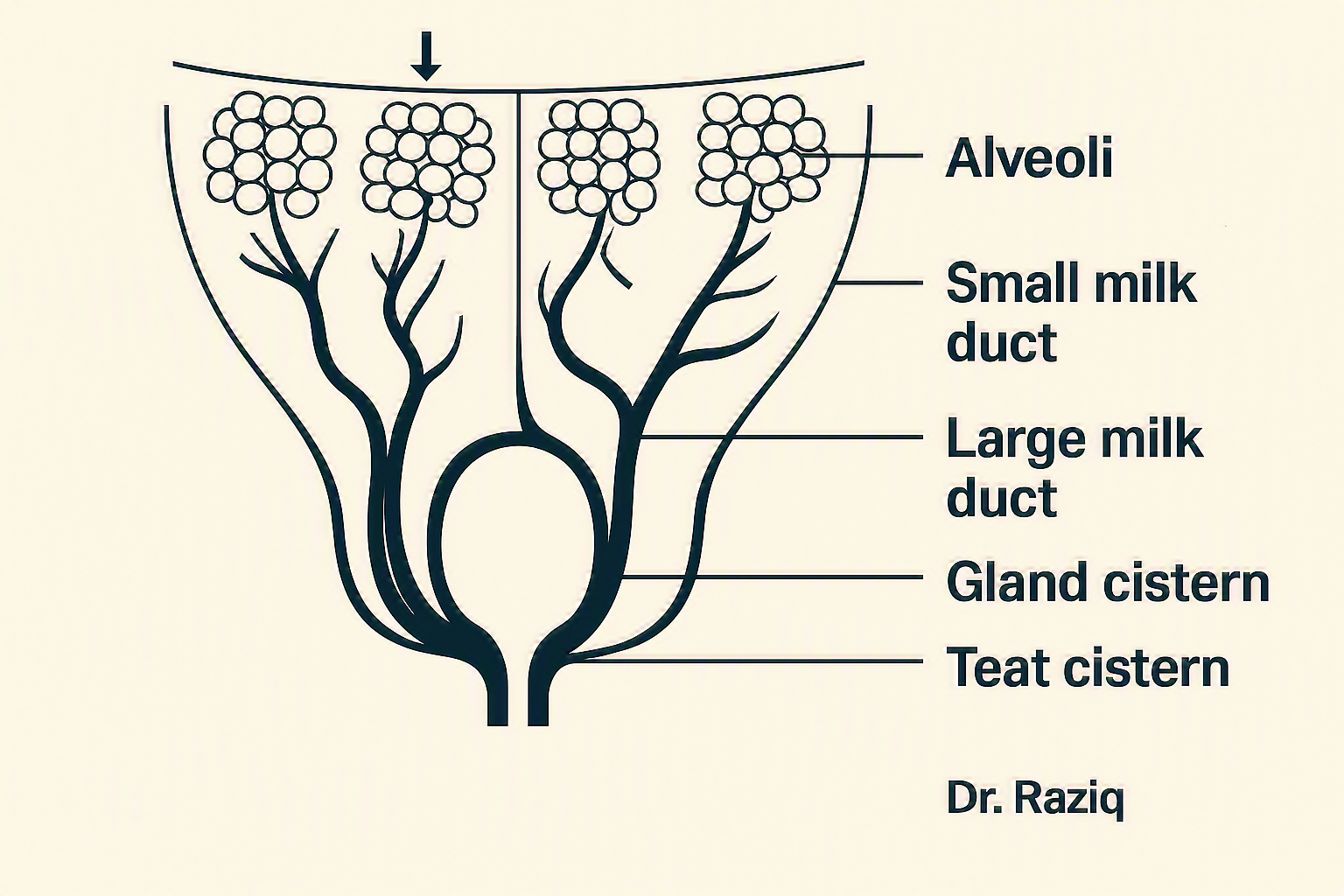
The internal structure of the camel udder
This sketch illustrates the internal structure of the camel udder.

This is one of the key reasons why mastitis is relatively less common in camels compared to other dairy animals [2][3]. The combination of alveolar milk storage, calf-driven milk let-down, and high antimicrobial protection makes the camel udder a naturally efficient and protected system.

At the same time, what protects the camel also benefits humans. When we consume camel milk, we benefit from lactoferrin’s antimicrobial, antiviral, and immune-supporting properties [2][4]. This makes camel milk a functional food with both nutritional and therapeutic value.

A Practical Message for Camel Dairy Systems

Understanding this natural system is important for modern camel dairies. Since milk let-down depends strongly on the calf, it is advisable to allow controlled calf presence during milking. This improves milk flow, reduces stress, and supports udder health. Future camel dairy designs should work with nature, not against it, by integrating calf stimulation into milking systems.

Conclusion

Lactoferrin in camel milk is not just beneficial for human health—it is a natural protective system engineered by evolution. Its high concentration, combined with the unique structure and function of the camel udder, demonstrates how nature has perfectly adapted the camel to produce safe, high-quality milk even under extreme conditions.

References

[1] Konuspayeva, G., Faye, B., & Loiseau, G. (2007).
Camel milk composition and nutritional value.
https://doi.org/10.1016/j.jfoodeng.2006.03.010

[2] El-Agamy, E. I. (2007).
The challenge of cow milk protein allergy.
https://www.sciencedirect.com/science/article/pii/S0924224406002290

[3] Ali, A., Baby, B., & Vijayan, R. (2020).
From desert to medicine: A review of camel milk.
https://www.ncbi.nlm.nih.gov/pmc/articles/PMC7276094/

[4] Dr. Abdul Raziq (Author).
Camel Milk Lactoferrin – Special agent against bacterial infections.
https://www.researchgate.net/publication/349695089_Camel_Milk_lactoferrin_Special_agent_against_bacterial_infections

[5] Camel4all.info Article.
Researching camel milk as an antiviral agent.
https://camel4all.info/index.php/2020/02/19/researching-camel-milk-as-an-antiviral-agent-in-the-context-of-covid-19/

Categories
General about camel

Camels vs Cows: Superior Mammary Development in Heat-Stressed Regions Makes Camels the Future of Dairy

Camel and the Power of Adaptation

In a warming world where heat stress increasingly limits dairy productivity, camels clearly outperform cattle due to their superior mammary development under extreme environmental conditions. Unlike cows, whose mammary growth and epithelial cell proliferation are significantly compromised by heat stress, camels maintain functional mammary development even under dehydration and high temperatures. Their unique mammary architecture—characterized by extensive alveolar milk storage and oxytocin-dependent milk release—supports sustained lactation in harsh climates. Additionally, the camel’s longer gestation period, approximately 12 months, supports enhanced prenatal development, including stronger mammary tissue formation. Combined with efficient energy and protein metabolism, these traits enable camels to sustain milk production from low-quality feed, making them ideally suited for climate-hit regions where conventional dairy systems struggle.

Camel Better Copes with the Stressful Climatic Conditions

Beyond physiology, camels represent a practical and strategic solution for global food security under climate change. Their inherent resilience allows them to thrive under extensive and low-input systems, where cattle would experience declines in productivity. Unlike cows, camel lactation is less dependent on optimal environmental conditions and can continue even during water scarcity, demonstrating a unique biological adaptation. Furthermore, camel milk is highly nutritious and enriched with antimicrobial proteins such as lactoferrin, offering both health benefits and improved shelf stability. These advantages make camel dairying especially relevant for arid and semi-arid regions, where rising temperatures and water limitations threaten traditional livestock systems. As global warming intensifies, camels emerge not just as an alternative but as a reliable and sustainable dairy species for future generations.

Camel has a unique body shape with a balance and developed udder
Camel has a unique body shape with a balanced and developed udder

Recent Findings Proved the Hypothesis

Recent findings from the Journal of Dairy Science further reinforce this perspective by highlighting the resilience of the camel mammary gland compared with that of bovines. The reviewed article emphasizes that while heat stress reduces mammary cell proliferation and milk yield in cows—and can even induce negative effects across future generations—camels demonstrate evolutionary adaptations that sustain lactation despite environmental stress. Their mammary system, dominated by alveolar storage and adaptive responses to dehydration, allows continued milk production under heat and water stress conditions. These scientific insights confirm that camels possess inherent physiological and cellular mechanisms that protect mammary development, making them more reliable dairy animals in a changing climate. Therefore, integrating camel-based dairy systems is not only a scientific recommendation but a necessity for ensuring long-term food and nutritional security in globally warmed regions.

Sketch of the structure of the camel udder

Reference

Choudhary, R. K., Puniya, A. K., Choudhary, S., Zhao, F.-Q., McFadden, T. B., & Capuco, A. V. (2026).
Effects of environment and management on mammary development in dairy animals.
Journal of Dairy Science.
https://doi.org/10.3168/jds.2025-28142 [Mammary gl…nt article | PDF]