Categories
camel milk Camel Physiology General about camel

Nature Has Engineered Lactoferrin to Protect the Camel’s Udder

What is Lactoferrin?

Camel milk is well known for its health benefits, especially because of a powerful natural protein called lactoferrin. Many people recognize its role in boosting human immunity and fighting infections. However, an equally important point is often overlooked: nature has designed lactoferrin primarily to protect the camel’s udder itself.

Camels live in harsh desert environments—hot, dry, dusty, and full of microbes. Under such conditions, maintaining strict hygiene, such as washing the udder regularly, is not always possible. To cope with this challenge, nature has equipped the camel mammary gland with strong internal protection. One of the key protective components is lactoferrin. In fact, camel milk contains 10–30 times more lactoferrin than cow milk [1][2], clearly showing its importance in protecting the animal.

Camel milk is delicious and healthy

The Structure of the Udder

The camel udder is also structurally unique. Most of the milk is stored in small alveoli (milk-producing units) rather than large cisterns as in cows [3]. Another important feature is that milk let-down mainly occurs when the calf approaches the mother, leading to frequent milk release throughout the day.

While frequent milk let-down keeps the milk fresh and supports calf nutrition, it also increases the chances of bacteria entering the teat canal. This could increase the risk of infections like mastitis. However, nature has already solved this problem. The high concentration of lactoferrin in camel milk acts as a continuous natural antimicrobial shield, protecting the internal lining, tissues, ducts, and cisterns of the udder.
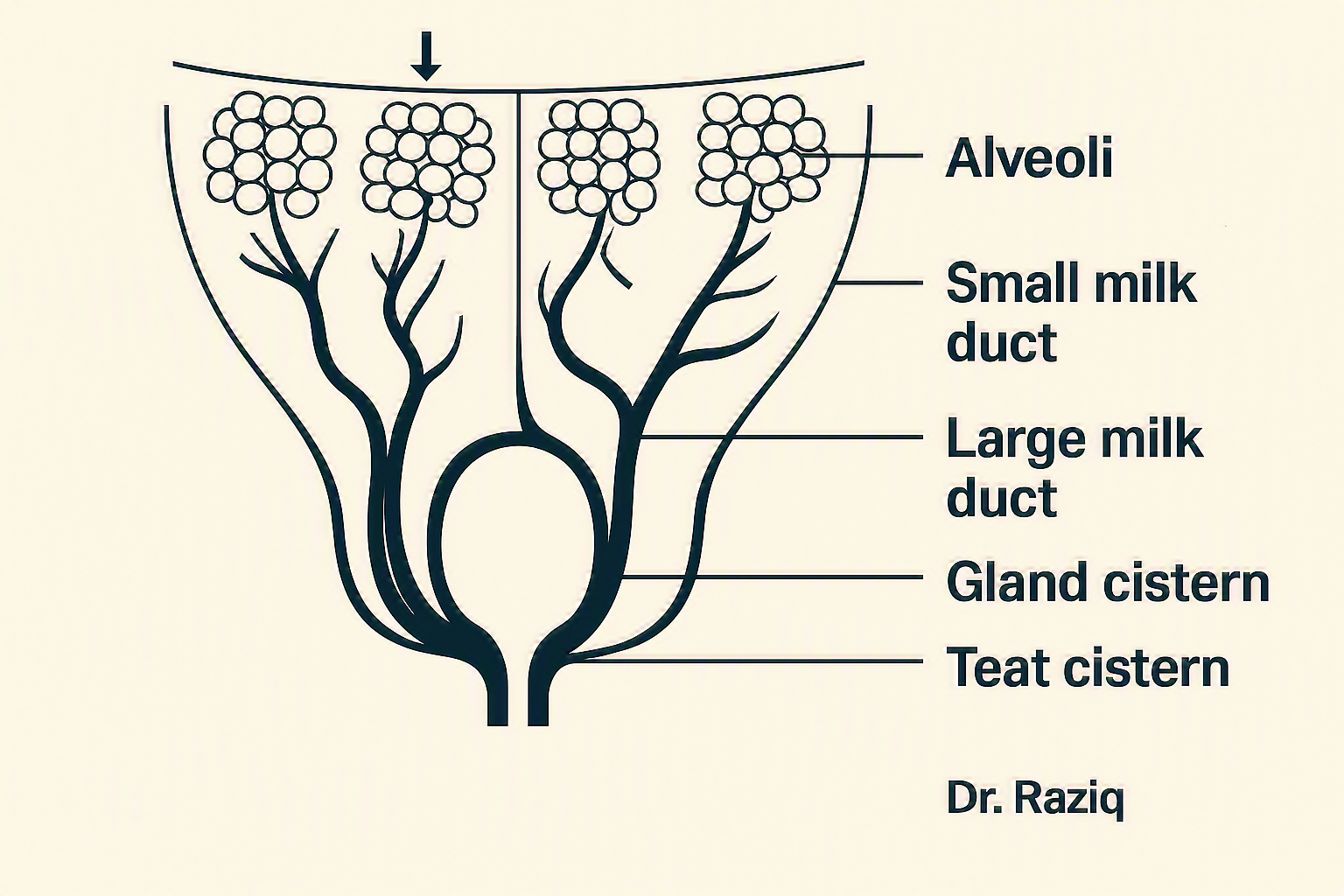
The internal structure of the camel udder
This sketch illustrates the internal structure of the camel udder.

This is one of the key reasons why mastitis is relatively less common in camels compared to other dairy animals [2][3]. The combination of alveolar milk storage, calf-driven milk let-down, and high antimicrobial protection makes the camel udder a naturally efficient and protected system.

At the same time, what protects the camel also benefits humans. When we consume camel milk, we benefit from lactoferrin’s antimicrobial, antiviral, and immune-supporting properties [2][4]. This makes camel milk a functional food with both nutritional and therapeutic value.

A Practical Message for Camel Dairy Systems

Understanding this natural system is important for modern camel dairies. Since milk let-down depends strongly on the calf, it is advisable to allow controlled calf presence during milking. This improves milk flow, reduces stress, and supports udder health. Future camel dairy designs should work with nature, not against it, by integrating calf stimulation into milking systems.

Conclusion

Lactoferrin in camel milk is not just beneficial for human health—it is a natural protective system engineered by evolution. Its high concentration, combined with the unique structure and function of the camel udder, demonstrates how nature has perfectly adapted the camel to produce safe, high-quality milk even under extreme conditions.

References

[1] Konuspayeva, G., Faye, B., & Loiseau, G. (2007).
Camel milk composition and nutritional value.
https://doi.org/10.1016/j.jfoodeng.2006.03.010

[2] El-Agamy, E. I. (2007).
The challenge of cow milk protein allergy.
https://www.sciencedirect.com/science/article/pii/S0924224406002290

[3] Ali, A., Baby, B., & Vijayan, R. (2020).
From desert to medicine: A review of camel milk.
https://www.ncbi.nlm.nih.gov/pmc/articles/PMC7276094/

[4] Dr. Abdul Raziq (Author).
Camel Milk Lactoferrin – Special agent against bacterial infections.
https://www.researchgate.net/publication/349695089_Camel_Milk_lactoferrin_Special_agent_against_bacterial_infections

[5] Camel4all.info Article.
Researching camel milk as an antiviral agent.
https://camel4all.info/index.php/2020/02/19/researching-camel-milk-as-an-antiviral-agent-in-the-context-of-covid-19/

Categories
Camel Milk for Health Cancer and others COVID-19 and camel milk Gut health

Camel Milk Lactoferrin! A Useful Tool Against the Infections

What is Lactoferrin?

Lactoferrin is one glycoprotein detected in livestock milk; as camel milk containing the highest amount in comparison to other livestock species. Lactoferrin boosts the immune system by protecting the cells against bacterial and viral infections and inflammations.

What does the Lactoferrin do?

The lactoferrin of mammalian species have been proved to inhibit the growth of some pathogenic strains in human and/or animal such as Escherichia coli, Salmonella typhimurium, Shigella dysenteriae, Listeria monocytogenes, Streptococcus spp., Vibrio cholerae, Legionella pneumophila, Klebsiella pneumophila, Enterococcus spp., Staphylococcus spp., Bacillus stearothermophilus and Bacillus subtilis

Lactoferrin helps in Keeping Healthy Gut Microbiome

Oral administration of lactoferrin reduces bacterial infections of the gastrointestinal tract and promoting the proliferation and growth of bacteria with low iron requirements such as Lactobacillus and Bifidobacteria as beneficial strains for the host.https://camel4all.info/index.php/2020/02/19/researching-camel-milk-as-an-antiviral-agent-in-the-context-of-covid-19/
Explore the Novel Antimicrobial Molecule ‘LACTOFERRIN’

Lactoferrin can reduce bacterial growth, inhibit bacterial adhesion and biofilm formation; thus, it might be considered an antimicrobial therapeutic agent.  Regarding the increasing resistance to antibiotics, it is necessary to explore novel antimicrobial drugs for bacterial diseases. https://camel4all.info/index.php/2014/12/12/super-food-camel-milk-can-beat-the-challenge-of-super-bug-bacterial-resistance-to-antibiotics/

For further details, click on the link below https://www.researchgate.net/publication/349695089_Camel_Milk_lactoferrin_Special_agent_against_bacterial_infections

Acknowledgment

The material and scientific support for this piece of work is provided by Dr. Tahereh Muhammadabadi, is Associate Professor and working on the healing power of camel milk. https://www.researchgate.net/profile/Tahereh-Mohammadabadi-2

Categories
Camelization of other continent Climate Change Adaptation Diabetes Indigenous Knowledge Natural Health and Camel Milk Symbiosis The Camel and Climate Change The Camel Science

Traditional Use of Camel Milk and Liver Health (Hepatitis)

The centuries-old tradition (healing with camel milk) is now supported by scientific findings gained in different quarters of the world. The camels’ pastoralists of Asia and Africa use camel milk as a natural pharmacy for different and complex ailments and such practice still, prevails among them. They use camels’ milk (CM) for the different complex ailments like hepatitis, joint problems, obesity, ascites, weaker eyesight, body aches and much more.

22045827_10210464762880669_8483970658450170896_n
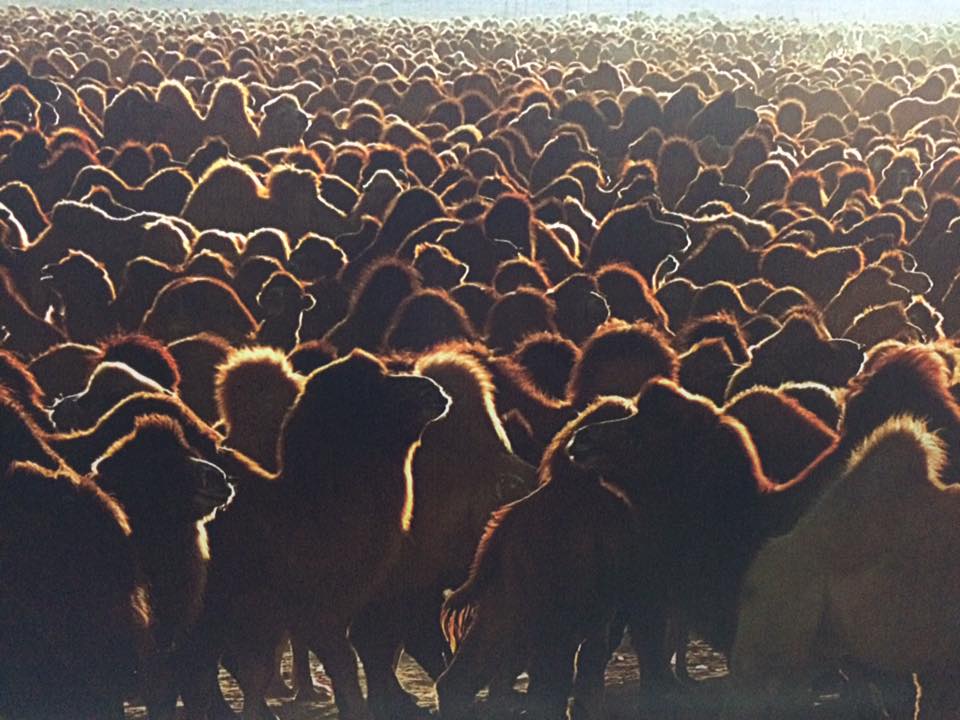
Mongolian Bactrian Camels

CM is successfully used for the treatment of hepatitis among different communities, even it is now used in urban areas of the world. Not only Traditional Knowledge (TK) but the religious sayings also supported such use of CM. According to a Hadeeth, Prophet Muhammad (PBUH) advised camel milk for the treatment of water belly (ascites) in Madina. There is very famous Hadeeth regarding the use of camel milk for the treatment of hepatitis.

images (5)
Camel Pastoralists Beleive in the Camel Milk Magic

Modern science and medical research also proved the importance of camel milk in human health. Famous US physician Dr. Hinkle has been very pleased with the results she is seeing with hepatitis on the camel milk. She has witnessed case after case of hepatitis patients whose liver enzymes have been normal for the first time in years while on the camel milk.

hepatitis-eye

Alla et al (2011)1 conducted research on camel milk in connection with the liver enzymes of hepatitis patient. They concluded that camel milk can be used as an herbal remedy for the treatment of alcoholism and other liver diseases which affect the hepatic enzymes as well as the liver tissues. Yagil (2004)2 stated that camel milk is very effective in fighting viruses. Viruses can also be neutralized by blocking out their enzyme activity, and studies have shown that camel antibody is an effective inhibitor of hepatitis enzymes system. Other studies conducted by Middle Eastern Scientists on the role of camel milk, revealed that camel lactoferrin was demonstrated a remarked in-vitro ability to completely inhibit the Hepatitis C Virus (HCP) entry into PBMC, hepG2, and replication inside those cells system (Esmail,2008). Such changes help in safeguarding the body from this killer virus.

camel pics stories
The desire for Camel Milk

The CM is a silver lining in the clouds for those who face liver dis-functioning. The scientific support for CMs’ potential is an additional asset which helps in convincing people with urban and academic backgrounds and asks for scientific proves. It is now pretty sure that CM turns the complexity into simplicity and makes the life easy and joyful. I hereby suggest those who have liver ailments and other complications to using camel milk for better health and a happy life.

References;

  1. Alla et al; 2011. Sudanese Journal of Public Health, Vol 6 (4) Esmail; 2008. Hepatitis Monthly; 8(2) 101-109
  2. Yagil; 2004. Camel Milk and Autoimmune Disease. Historical Medicine