Categories
General about camel

Camel is a Solution, Not a Problem

Camel and the Power of Adaptation

Camel is a precious animal genetic resource, highly adapted to the harsh and hostile ecosystems. Camels rely on woody and scanty vegetation and efficiently convert them into precious food (milk & meat) and other items (wool, manure, bones, etc.). The camel is composed of unique DNA, making it the most efficient biological machine both in the consumption of inputs and production of the outputs.

A Group of Brela Camels
Highly Adapted Brela Camel of Pakistan

Camel is an Efficient Biological Machine

The camel produces in harsh environments where other animals are difficult to survive. In the climate change scenario, the camel is the most suitable animal to be used as an agent of food security. Camel relies on the marginal lands which are unable to produce crops or support agrifarming. Water is the major limiting factor of drylands and camel is the most efficient animal in the water economy (lowest water footprint). https://www.youtube.com/watch?v=r4h1E7WHKds
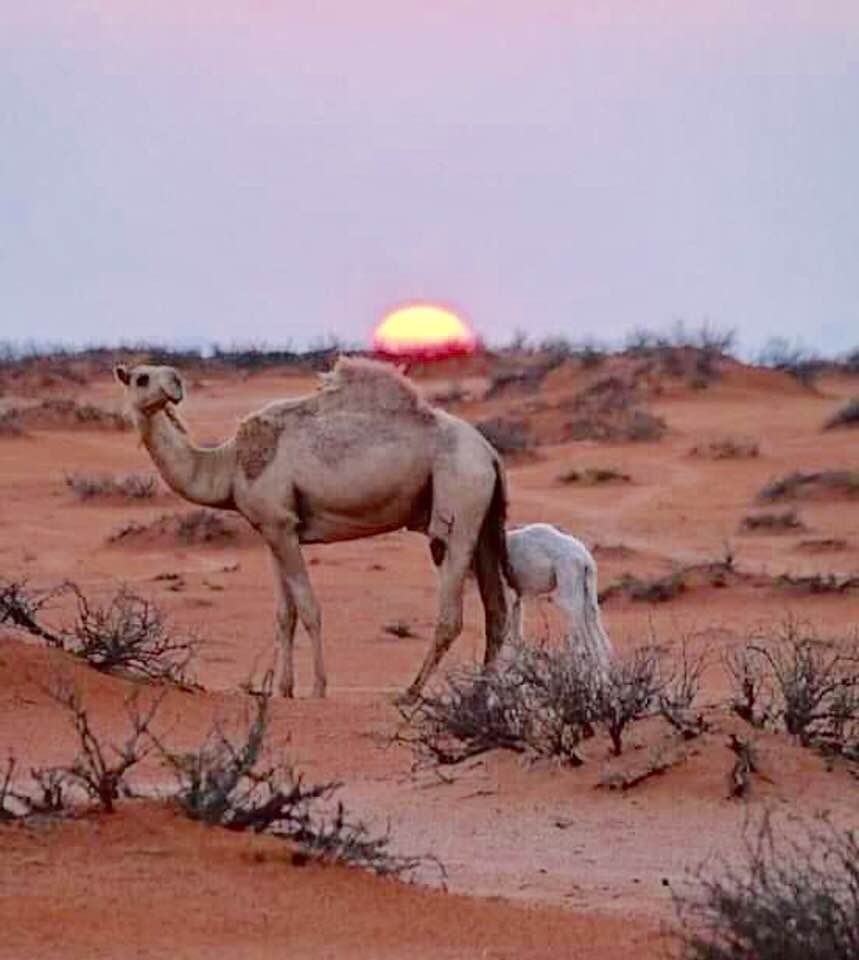
Camel Relies on the Woody Vegetation
Camel is the beauty of the desert

Camel is Neglected

Unfortunately, camel is always neglected while formulating policies for food security under climate change context. Recently, the Australian government decided to kill camels for water conservation. One can just realize how stupid this act is as the camel is the solution, not a problem. I hereby share the link of a film, you will weep to see the massacre of camel shoot. https://www.youtube.com/watch?v=V61_07V1jC4
The Camels love Tree Vegetation
The Camels are Happy Browsers

Camel is under threat in its natural habitats as well and one of the best examples is the camel sinking in the Rajasthan desert. https://camel4all.blog/2017/09/25/a-beautiful-camel-heritage-is-sinking/

There are many reasons for this sad state of the situation, all are man-made. The bushfire in the Australian continent is not because of the camel but the soaring heat because of climate change.

Utilization is the Best Conservation

It is the utmost need of time to conserve camel with the perspectives of camel herders, climate scientists, and food security activists. But the top priority must go the camel keepers as they are one in all. Utilization is the best conservation. The Australian government should take the camel as an opportunity but not a threat. Camel milk (top priority) and meat can be good tools for its utilization and ultimately conservation.

Categories
Camel in Australia General about camel

Camel Journey ~ From its Original Habitat to Modern World

Camel’s role is incredible in its cradle of domestication and its original habitats. In the 19th Century, some camels were transported to the USA, Australia, and some other places for work and armies. After the automobile revolution, the role of the camel as a beast of burden was gradually diminished 1,2.

In Australia there are thousands of feral camels, now it’s estimated a million, roaming across Australian deserts but unfortunately considered as a pest. The government launches a project to kill camel (considering as a pest) and save the scarce water resources in region 3. Many friends from Australia and other parts of the world (including the author) raised voice to halt such killing which results in wastage of such a unique resource. The camel activists gave many good arguments/suggestions to save feral camel; a tool to adapt to the climate change and judiciously use of the scattered bushy vegetation of the region 4. Unfortunately, there are still many challenges, the main one is the weak faith and poor understanding of the present Australian government on the onset of climate change 5.

I appreciate the role of the colleagues and friends around the world who raised voice for the conservation of camel in Australia and converting camel from a useless animal to the best tool for adaptation to climate change and ensuring food security. Now my dream about camel ‘Turning from a beast of burden to a modern farm animal’ is turning true 6Camel is Turning from a Beast of Burden to a Modern Farm Animal

In this series of articles, I am starting to share links, photographs, and views of the people around the world, who floated the idea to the sustainable use of camel for the well being of humanity. Modern science also proved the role of the camel in all aspects especially, food security, sustainability, resilience, and adaptation to climate change and human health. All friends and colleagues are warmly welcome to freely review, comment, share in this series of knowledge sharing.

As a first innovation, I hereby share pictures sent by Hannah Purs from Australia. I hope she will respond to reviewers.

20150414_173557
Photo credit Hunnah Purss
Hannah Training Camel from Dairy
Camel Feeding on Hay
Photo credit Hannah Purs
SONY DSC
Feral camels are gathered by Helicopter. Photo credit Hannah Purss

References 

  1. http://en.wikipedia.org/wiki/United_States_Camel_Corps
  2. http://en.wikipedia.org/wiki/Australian_feral_camel
  3. http://www.foxnews.com/scitech/2011/06/09/australia-considers-killing-camels-to-tackle-climate-change/
  4. http://www.dailytelegraph.com.au/newslocal/news/hannah-purss-embarks-on-2000km-camels-for-drought-relief-trek-along-oodnadatta-track/story-fngr8gwi-1226926025959
  5. http://rt.com/news/256861-climate-change-un-hoax/
  6. https://camel4milk.wordpress.com/2014/11/01/camel-is-turning-from-a-beast-of-burden-to-a-modern-farm-animal/
Categories
Camel and Nature Connection Camel in Australia Camel Milk and Natural Health

Camel milk can make Fortune for South Australia

The camel milk is finding its way in the new world  (from sand dunes of Arabia to the western world) because of its hidden treasures of health promising ingredients.

Traditionally used for complex and diverse diseases in its habitat, camel milk is now praising in the Western world both by modern families and the Scientists. New small and medium enterprises in the USA (Oasis Camel Dairy) and EU (Holland) with the production of camel milk are emerging. The demand is very high and the owners (personal communication) received emails and phone calls from different places to ensure availability of this precious milk for their kids with Autism.

The idea of camel milk as a tool for great health, business, and livelihood is appealing. Now the people are hearing. I hope/wish the policymakers in the camel world will realize the reality. I hereby copy the link of another Autism work in the below lines.

A beautiful Naqa with her calf enjoying the happiness of the nature

New and innovative ideas are being initiated and many new people are willing to come in the camel world. Here, I link the readers with the camel development in South Australia by Hannah Purs.

SOUTH Australia can expect a new industry to emerge in the next few months with preparations underway for SA’s first commercial camel dairy. Port Broughton couple Evan Casey and Hannah Purss say they have spent years setting up their enterprise and are waiting for their herd of 20 female camels – known as cows – to give birth. Ms. Purss said the original drive behind the dairy idea was to remind people of the value of the species. “We’ve worked with camels for a number of years up in the NT, doing a lot of wild camel work,” she said. “There was a lot of money being spent by the government to cull camels. We were looking at ways they can be seen as more important.” They realized a dairy would be a good option and began research into the product.

The link is given below for further reading; https://www.stockjournal.com.au/story/3367478/camel-milk-potential-for-sa/

The beautiful white camels of Suleiman Mountainous Region of Balochistan Pakistan.
Categories
CaM Product and Cheese General about camel Natural Health and Camel Milk

Arrera- Traditional defatted buttermilk from Ethiopia

Arrera has a pleasant odor and taste and a similar color to ergo with a slightly smoother appearance and a thinner consistency. Its consistency is though thicker than that of fresh milk. It has also a much shorter shelf life compared to all other fermented milk products (only 24-48 h), even when smoke is applied to the equipment used for its storage.

This fermented milk product is consumed in all parts of the country as a beverage either plain or spiced. It is preferred by women for consumption as a side dish or as a drink. Being rich in several nutrients, it serves to enrich the diet. It is given to weaning aged children and elderly and is especially considered as food of children and women in rural areas. Surpluses are given to calves, lactating cows and dogs. It may indirectly serve as additional income for the women by its use as raw material for cottage cheese production, which may be sold in the market. Due to its relatively short shelf life and some traditional taboos or beliefs, Aarea is not sold in the market for direct consumption.

This information is shared by;

Junior Product Manager at Chr. Hansen A/S

This fermented milk product is consumed in all parts of the country as a beverage either plain or spiced. It is preferred by women for consumption as a side dish or as a drink. Being rich in several nutrients, it serves to enrich the diet. It is given to weaning aged children and elderly and is especially considered as food of children and women in rural areas. Surpluses are given to calves, lactating cows and dogs. It may indirectly serve as additional income for the women by its use as raw material for cottage cheese production, which may be sold in the market. Due to its relatively short shelf life and some traditional taboos or beliefs, Arrera is not sold in the market for direct consumption.